Showing posts with label Lakers. Show all posts

4/19/18

D-G-S Lake Birds

Lake Birds depend on ponds, lakes, and waterways for survival. They nest and feed and spend their life on shore and water. Here are some of the water-birds I have caught with my lens. 
(Also see Shore Birds) Herons, Egrets, Storks etc.

 Large Lake Birds
                                            Cormorant                        Cormorant                            Cormorant 
Anhinga                             Dbl Crested                         Little Pied                        White Brested

Small Lake Birds
Pied Billed Grebe            Moorhen                 American Coot               Common Loon


4/14/18

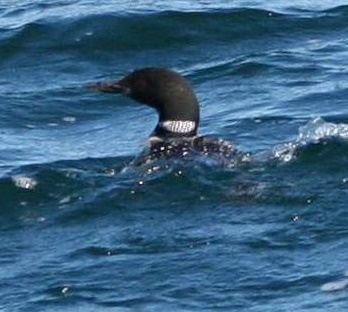
Common Loon


Common Loon 
(Gaviaimmer)
Photographed on Muskoka Lake, ON, Canada July 2005

The eerie yodel of the Common Loon is a symbol of the wild North. The territorial call of the male loon can be heard from lakes across Canada to the very northern United States.

Loons are water birds, only going ashore to mate and incubate eggs. Their legs are placed far back on their bodies, allowing efficient swimming but has awkward movement on land. Loons mate for life and can be seen traveling together.

The Common Loon is flightless for a few weeks after moulting all of its wing feathers at the same time in midwinter.


American Coot


American Coot 
(FulicaAmericana)
Photographed in Dana Point, California    Jul 2008
  
Often mistaken for a duck, the American Coot is a common water bird. It’s all black body and white chicken-like beak distinguishes this swimming rail from the real ducks.

Although it swims like a duck, the American Coot does not have webbed feet like a duck. Instead of having all the toes connected by webs, each coot toe has lobes on the sides of each segment.


An awkward and often clumsy flier, the coot requires long running takeoffs across the water’s surface to become airborne.

Although the coot will consume grains, grasses, and agricultural crops on land, it generally forages in or under water, where it is almost exclusively an herbivore. 


Moorhen


Common Moorhen
(Gallinulachloropus)
Photographed in the wild,
Everglades, Florida       Mar 2012
Dominican Republic     Sep 2016


The most widely distributed member of the rail family, the Common Moorhen inhabits marshes and ponds from Canada to Chile, from northern Europe to southern Africa, and across Asia to the Pacific. Vocal and boldly marked, the species can be quite conspicuous, sometimes using its long toes to walk atop floating vegetation.

The Common Moorhen has long toes that make it possible to walk on soft mud and floating vegetation. The toes have no lobes or webbing to help in swimming, but the moorhen is a good swimmer anyway.

The Common Moorhen sometimes lifts its feet out of the water in front of the body while swimming, perhaps to pass over vegetation.


Pied Billed Grebe

Pied-Billed Grebe
 Podilymbuspodiceps
Photographed in the wild, Naples, Florida   Mar 2007

This is a small, diving bird that feeds on aquatic insects, small fish, and crustaceans. This Grebe is very shy and dives underwater or hides in aquatic vegetation when scared. These are solitary birds. Their nests are designed to float on the water’s surface, but are usually attached to some vegetation.

Pied-Billed Grebes are monogamous over the breeding season. The young can often be seen riding on their parents' back. A small brown stocky body with short thick whitish bill with a black ring (breeding season). Its feet are set far back on its body. Pied-Billed Grebes have a whitish throat with darker crown and back.  It has been known to grow up to12 - 15 inches in full length.


Cormorant (white Breasted)

White Breasted Cormorant
Phalacrocoraxcarbolucidus
Photographed at Toronto Zoo, Toronto Canada Sep 2011


Largest African Cormorant 85-95 cm, the White-breasted Cormorant is the only form of the Great Cormorant found in sub-Saharan Africa. A fish and frog eater with a white throat and breast - yellow at base of throat. The white-breasted cormorant is able to swallow larger than the normal diameter of its neck because a unique musculature of the neck allows it to stretch out. 


The throat, or gular pouch, is also used as a signaling device and as a means for cooling the body. By panting and fluttering the gular pouch, blood passing through the rich concentration of capillaries is rapidly cooled.


Cormorant (Little pied)


Little Pied Cormorant 
Microcarbomelanoleucos
Photographed at Toronto Zoo, Toronto, Canada  Sep 2011

The Little Pied Cormorant is entirely black above and white below. The face is dusky and, in adult birds, the white of the underside extends to above the eye. Immature birds resemble the adults except there is no white above the eye.


Little Pied Cormorants breed either in colonies or, less commonly, in single pairs. The nest is a flat platform of sticks, lined with green leaves and is usually placed in a tree. Both adults share in egg incubation and care of the young.

Cormorants are equally at home in freshwater and saltwater environments and can also be found in inland wetland environments.  Cormorants have a special membrane which covers their eyes and helps them see underwater.


Cormorant (Dbl Crested)

Double Crested Cormorant 
(Phalacrocoraxauritus)
Photographed on Naples, Florida  Apr 2008
Etobicoke Creek, Toronto Canada  June 2012


Double-crested cormorants are usually found in flocks, and are one of only two species that prefer fresh water. In the mid-twentieth century, populations were seriously reduced due to DDT use, but have begun to bounce back.


Cormorants feed principally on slow moving or schooling species of fish. Their increase in population has made them a major predator in the northern areas causing a reduction of young fish in the smaller lakes.


Can be found on rock islands and gather in colonies. It is common to see them with their wings spread out to let the sun dry their un-oiled wings


Anhinga


Anhinga 
(Anhinga anhinga)
Photographed in the wild, Naples, Florida      Apr 2007


A bird of southern swamps, the Anhinga is known as the Water-Turkey for its swimming habits and broad tail, and also as the Snake-Bird for its habit of swimming with just its long head and neck sticking out of the water.
Its long-serrated dagger-shaped bill is ideally suited for catching fish, which it stabs and then flips into the air and gulps down headfirst. Cormorants and Anhinga’s lack of oil glands with which to groom so they must perch in the sun with their wings half open to dry.


The Anhinga is frequently seen soaring high in the sky overhead. It is a graceful flier and can travel long distances without flapping its wings, much in the manner of a Turkey Vulture.