Showing posts with label HoneyCreeper. Show all posts

4/16/18

Turquoise HoneyCreeper

Turquoise Honey creeper-
(Blue Dacnis)
 Dacniscayana
Photographed at Toronto Zoo, Toronto, Canada   Sep 2011

The Turquoise Honeycreeper, also called the Blue Dacnis, is a small tanager distributed throughout parts of Central American and tropical South America. It is generally in mating pairs or found even in mixed species flocks.

Blue Dacnis males are bright blue with a black throat, black above the bill and around the eyes, mostly black wings, and a black tail. The females are bright green with a bright blue head and blue shoulders. Both sexes have red eyes, reddish legs and feet, and a sharply pointed bill with a reddish base.


Red-legged HoneyCreeper

Red-legged Honey Creeper  
Cyanerpes cyanus
Photographed at Toronto Zoo, Toronto, Canada   Sep 2011


Red-legged Honeycreeper is very gregarious outside breeding season. It is often seen in pairs or in small groups of up to 5 to 15 birds, but large flocks of about 100 birds can congregate at food source, such as flowering trees. This Honeycreeper alone is seldom seen without another close by.

Red-legged Honeycreeper usually forages in canopy, searching for insects on small branches, or catching them in flight. It also feeds lower, picking ripe fruits for reaching the seeds inside.

It is able to extract the pulp of an orange through the holes made by woodpeckers. It also takes nectar from flowers, thanks to its long curved bill. These birds are very active and restless.


Purple HoneyCreeper

Purple Honey creeper
Cyanerpescaeruleus
Photographed at 
Discovery Cove, Orlando, Florida  Mar 2011


The Purple Honeycreeper is a small bird in the tanager family. It is found in the tropical New World from Colombia and south to Trinidad.

Though it is most frequently seen in the lowlands up to 3,300 ft. or so, it has been encountered as high as 7,500 ft.

Purple Honeycreeper is gregarious and lives in small groups, but it can be seen in mixed flocks with other honeycreepers.

It feeds on fruits, often hanging upside down in order to reach the seeds inside the open ripe fruits.


HoneyCreepers

Click on the TITLE to see more details


Akiapola'au                     Amakihi                          Apapane                                  Purple


Red-legged                         Turquoise

The typical honeycreeper is a small bird in the tanager family. They are found in the tropical New World from Mexico south to Brazil. Hawaiian honeycreepers is a group of birds in the finch family.

They occur in the forest canopy, and, as the name implies, they are specialist nectarfeeders with long curved bills.


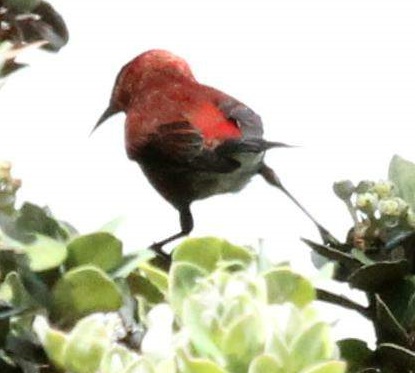
Apapane


ʻApapane Honeycreeper
Himatione sanguinea
Photographed in the wild, Mauna Kea, Hawaii  Mar 2014

Endemic to Hawaii the ʻApapane are found at an elevation above 4,100 feet keeping the birds away from avian malaria carrying mosquitoes that can wipe out the species. The bright crimson feathers of the ʻApapane were once used to adorn the clothing of the Royal Hawaiian Kings and Queens.


ʻApapane rely heavily on the nectar of the `Ohia-lehua blossoms, which flower at very different times throughout the islands. Breeding season extends at least from December until July, often with two clutches being produced by a pair in a given year. Nests are usually found in the tops of `Ohia-lehua trees. ʻApapane are primarily nectar feeders, but occasionally take insects and spiders, especially when feeding their young.


Amakihi

Hawwai‘i‘Amakihi Honeycreeper
 Hemignathus virens
Photographed in the wild, Mauna Kea, Hawaii  Mar 2014

The Hawaiʻi ʻAmakihi (Hemignathus virens), also known as the Common ʻAmakihi, is a species of Hawaiian honeycreeper and is endemic to Hawaii. It is one of the most common honeycreepers, inhabiting all types of habitat on the islands at elevations from sea level to 8,000 feet

During the breeding season, between January to March, It makes a small nest made of woven plant fibers, and in most cases lays only a single egg. Only in rare cases does this bird lay two eggs. The chick(s) hatches after two weeks and out comes a baby that is naked except for a couple of yellow feathers. After two to three weeks, the chicks are fledged and then off to find a new territory of their own


HoneyCreepers